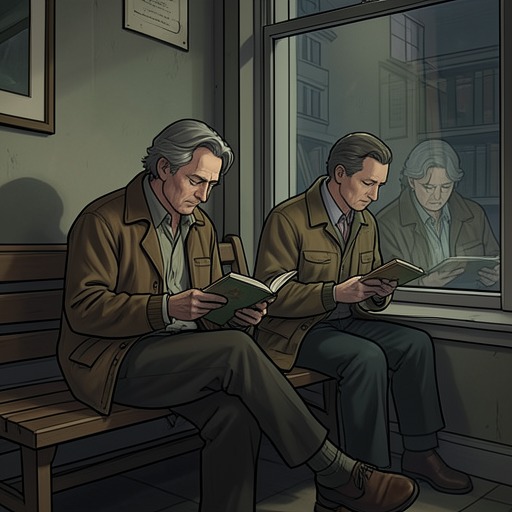
“honest through lies”
A Man“honest through lies” is Kido’s description of a temporary refuge from direct self-examination: he keeps himself together by living other people’s pain, using borrowed histories to approach truths about himself that he cannot yet face. The phrase’s paradox deepens when Rié, confronting her dead husband’s false identity and the reality of their marriage, wonders whether sincerity performed through deception can itself become the ultimate lie.
Kido’s borrowed way of living
Kido explains the practice after the narrator challenges him for telling lies about his personal history. He admits that he maintains his sense of self by living through other people’s pain, and compares the process to the saying about a person who goes mummy hunting and ends up a mummy. The image turns his method into a risk: entering another person’s suffering may preserve him for a time, but it can also draw him into the very condition he seeks to approach from the outside.
His honesty is qualified rather than complete. Kido says that the practice occurs in brief stints, in places such as the one where he is speaking, and that somehow he cannot let go of himself entirely. Beneath the lies, he wants to think directly about his own life; doing so, however, makes him sick. He believes the need to act this way may eventually pass, but cannot say how or when. The expression therefore describes both a coping method and its limit: borrowed experience offers temporary relief without dissolving the self it helps him evade.
The narrator’s response
The confession changes the narrator’s response to Kido. His behavior initially seems tasteless, and the narrator asks why he tells such lies; Kido pauses before explaining himself with what the narrator perceives as an intensely lonely smile. The narrator remains put off by Kido’s deliberately mysterious manner, yet finds the substance of the disclosure fascinating and acknowledges a growing affection for him. The scene thus presents the phrase not as a simple justification for deception, but as an unsettling disclosure that can provoke both resistance and closeness.
Rié’s question about performed sincerity
The phrase acquires a sharper, more painful resonance in Rié’s reflections on her husband. She remembers three years and nine months of marriage as the happiest period of her life, but the discovery that his personal history was false makes those memories seem unstable: like a spinning top, they had appeared coherent until his abrupt death stopped them. She fears that the life she shared with him may have left her carrying an uncanny likeness to the nameless identity he bore.
Looking at his photograph, Rié wishes she had a name by which to call him. She cannot settle the contradiction between the deception and the intimacy they experienced: she believes there must have been a good reason for what he did, yet wonders why he did not tell her during the four and a half years from their meeting onward, when they had trusted one another and he had opportunities to speak. Her question about whether consummately performed mendacious sincerity could be the ultimate deception does not erase the marriage’s lived happiness; it makes that happiness harder to interpret. The expression thus links Kido’s temporary, conscious borrowing of other people’s pain with Rié’s more devastating uncertainty about a false identity that was also the basis of a real shared life.